Metal Debris Detection System SYAD100
High-Reliability Calibration and Verification Platform for Metal Debris Detection Systems under Temperature ––– Vibration Coupled Environments
Product Description
I. Product Overview
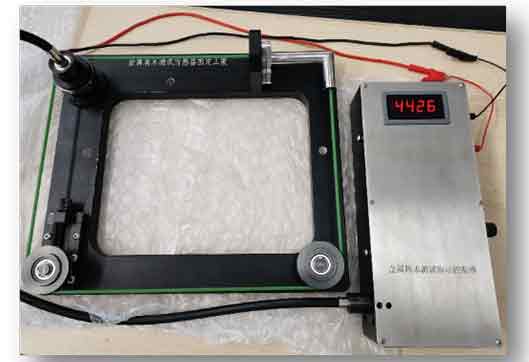
The SYAD100 Metal Debris Detection System is a high-precision calibration and environmental verification platform developed for aerospace, propulsion, and industrial transmission systems. It is engineered to perform functional verification, ratiometric calibration, and performance characterization of metal debris sensor subsystems under extreme thermal conditions.
The system enables quantitative assessment of sensor signal conditioning circuits, including evaluation of temperature-induced offset drift, gain drift, and noise variation, ensuring reliable sensor operation under complex operational environments.
This system adopts an innovative “remote drive with flexible shaft transmission” design, providing thermal decoupling between the drive system and high-temperature chamber environment. This architecture prevents thermal degradation of motor windings and power drive electronics, guaranteeing long-term stable operation within –55°C to +180°C.
The mechanical design is vibration-test compatible, supporting combined temperature–vibration environmental simulations.
II. Key Technical Advantages
III. System Architecture and Engineering Design
IV. Technical Specifications
V. Typical Application Scenarios
The SYAD100 Metal Debris Detection System is a high-precision calibration and environmental verification platform developed for aerospace, propulsion, and industrial transmission systems. It is engineered to perform functional verification, ratiometric calibration, and performance characterization of metal debris sensor subsystems under extreme thermal conditions.
The system enables quantitative assessment of sensor signal conditioning circuits, including evaluation of temperature-induced offset drift, gain drift, and noise variation, ensuring reliable sensor operation under complex operational environments.
This system adopts an innovative “remote drive with flexible shaft transmission” design, providing thermal decoupling between the drive system and high-temperature chamber environment. This architecture prevents thermal degradation of motor windings and power drive electronics, guaranteeing long-term stable operation within –55°C to +180°C.
The mechanical design is vibration-test compatible, supporting combined temperature–vibration environmental simulations.
II. Key Technical Advantages
- Wide Temperature Operating Capability
- Sensor mounting region temperature range: –55°C to +180°C
- Suitable for aerospace and high-reliability industrial environmental validation
- Supports thermal cycling, high-temperature endurance, and accelerated life testing
- High-Dynamic Particle Motion Simulation
- Particle carrier linear velocity: 0–10 m/s
- Accurately simulates lubricant flow velocity and debris transport conditions in rotating machinery
- Supports continuous variable speed control for dynamic response testing
- Modular Multi-Configuration Compatibility
- Compatible sensor bore sizes: 13 mm / 18 mm / 22 mm
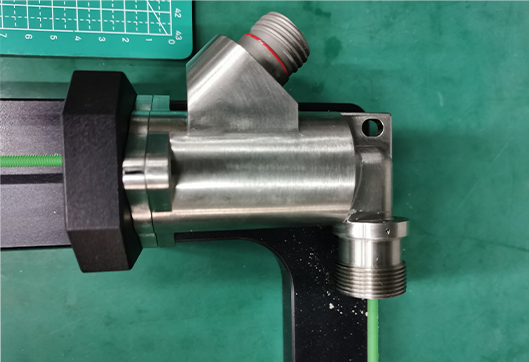
- Supports both Straight-type and Elbow-type sensor geometries
- Modular mechanical interface design for rapid reconfiguration
- High-Precision Calibration and Classification Capability
The system enables quantitative simulation of metallic particles with varying material properties and particle sizes for performance validation.
- Ferromagnetic particle detection capability: ≥125 µm
- Non-ferromagnetic particle detection capability: ≥450 µm
- Maximum validated particle size: >700 µm
- Channel classification accuracy up to 100%
- Counting accuracy up to 100%
- Test data can be used to establish:
- Sensor sensitivity curves
- Detection Probability (POD) models
- False alarm and missed detection statistical models
III. System Architecture and Engineering Design
- Drive System Configuration
- External DC Motor + Flexible Shaft Transmission
To prevent thermal stress on motor windings and power drive electronics, the drive source is located outside the thermal chamber.
- Drive Motor Specifications:
- Rated voltage: 24 VDC
- Rated power: 120 W
- Maximum rotational speed: 4000 rpm
- Bidirectional operation
- Stepless speed regulation (PWM or analog control interface)
- Flexible Drive Shaft:
- Diameter: 10 mm
- High-strength, high-temperature resistant construction
- Pass-through chamber aperture design to minimize thermal conduction
This configuration ensures physical decoupling between the drive system and environmental stress conditions.
- Internal Chamber Working Platform
- Structural Materials:
- Base: 45# carbon steel (high rigidity, low deformation)
- Frame: Al6061 aluminum alloy (lightweight structural optimization)
- Total system weight: <15 kg
The structural design balances mechanical stiffness and portability and is suitable for installation on electrodynamic vibration tables.
- Belt Tensioning Mechanism:
- Manual rotary adjustment rod with handwheel
- Real-time driven pulley position adjustment
- Prevents belt slippage under high rotational speed or vibration conditions
- Ensures long-duration cyclic test stability
- Particle Carrier System – High-Temperature Wear-Resistant Belt
- Transmission Belt:
- Diameter: 4 mm
- High-temperature resistant composite material
- Designed for thermal fatigue resistance and wear resistance
- Particle Fixation Method:
- Standard test particles (e.g., tin spheres) are thermally embedded into the belt surface
- Prevents particle detachment during high-speed circulation
- Ensures repeatability and consistency of calibration tests
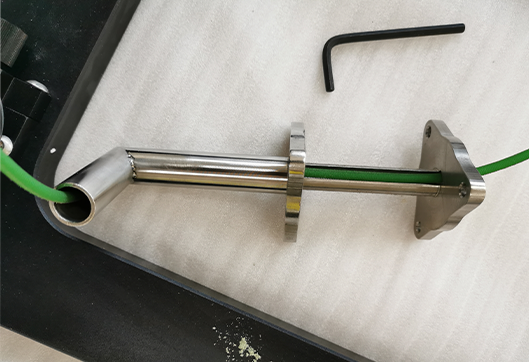
- Sensor Guidance and Friction-Reduction Assembly,Belt Guide Structure:
- 12 mm guide assembly designed for elbow-type sensors
- Integrated guide groove and low-friction pulley system
- Reduces frictional heating between belt and guide
- Enhances long-term operational reliability
IV. Technical Specifications
- Mechanical and Environmental Parameters
| Parameter | Specification |
| Compatible sensor bore | 13 mm / 18 mm / 22 mm |
| Sensor configuration | Straight / Elbow |
| Particle carrier velocity | 0–10 m/s |
| Sensor-end temperature range | –55°C to +180°C |
| Total system weight | <15 kg |
- Metallic Particle Detection Performance
(Based on 13 mm inner-diameter sensor example)
| Particle Type | Size Range | Channel Classification Rate |
Counting Accuracy |
| Ferromagnetic | 150–300 µm | ≥90% | ≥90% |
| Ferromagnetic | 300–500 µm | 100% | 100% |
| Non-ferromagnetic | 500–700 µm | ≥80% | ≥90% |
| Non-ferromagnetic | >700 µm | ≥95% | 100% |
The acquired data supports construction of sensor sensitivity curves and statistical models for false detection rate analysis.
V. Typical Application Scenarios
- Temperature Drift Analysis
Used to evaluate under wide temperature conditions:
- Offset drift
- Gain drift
- Noise variation
Applicable to signal conditioning circuits and magnetic sensing front-end stability verification.
- Quantitative Calibration and Threshold Validation
By simulating repeated passage of standardized particles, the system enables:
- Minimum detectable particle size verification
- Material discrimination capability evaluation
- Counting error rate assessment
- Threshold and filtering algorithm optimization
- Combined Temperature–Vibration Environmental Testing
- Flat-base structural design
- Mountable on vibration test systems
- Integrated with thermal chambers for HALT/HASS-style combined environmental testing
- Suitable for aerospace propulsion systems and high-reliability industrial transmission verification